Those of us engaged in producing knowledge about the phenomenon of language are invariably forced to come to terms with the quality of the prose we write, as much as we are forced to consider our own subjectivity. With regard to both of these things, there are no legitimate reasons that what we write should not be subject to the same standards as that of others, particularly when we are deliberately attempting to contribute to and influence scholarly discourse. We are social beings, every bit as much as our subjects, our colleagues, and the general reading public—which is to say that we operate as social beings when trying to influence these audiences. Grammars and dictionaries, on the other hand, provide us with one of the precious few remaining opportunities to assume what Stephan Palmié calls “the terrible fiction of a voice from nowhere” and not worry too much about the quality of our own prose or, for that matter, our own subjectivity. Perhaps this is why some philologists naturally gravitate to writing dictionaries and grammars.
And then you have Rudolf Macuch. The 20th century Slovak philologist was not only painfully aware of his own position with respect to his subject, but he also never lets us forget it. His Handbook of Classical and Modern Mandaic is a landmark of 20th century scholarship, if only because it is sui generis among grammars. Its first 25 pages establish it as a very personal account of a language, situating him within his own scholarly context through a painstakingly detailed critique of the work of his predecessors and contemporaries. At no point does Macuch ever adopt the terrible fiction of a voice from nowhere; instead, he makes certain that his voice is heard on each and every page.
Philologists are basically people who do things with words, and the primary thing that Macuch attempts to do with his Handbook is to document his personal discovery of both Classical and Modern Mandaic. In a very real sense, neither existed prior to 1965 (please bear with me on this) and he wants us to know that he was present at their making. In fact, he outlines the case that he has played a pivotal role in this making.
On p. XLVI, he informs us that “The existence of a vernacular dialect spoken by Mandaean laymen in Khuzistan, which as a living language deserves, at least, as much attention as the traditional pronunciation of the literary tongue, remained completely unknown until my personal discovery at the occasion of my visit to the Mandaean community of Ahwaz in 1953.” Unknown to whom? Obviously, by “completely unknown,” he does not mean that it was unknown to the native speakers he met, or to the thousands of their coreligionists in both Iraq and Iran, who have always been painfully aware of the ongoing shift from Mandaic to Arabic. Nor can he mean that it was unknown to his more recent scholarly predecessors, such as Jean Jacques de Morgan, who traveled to Iran and collected some texts in this language, or Samuel Marinus Zwemer, who lived in Basra around the turn of the century and published some samples of vernacular Mandaic in his Arabia: The Cradle of Islam, or Stefana Drower, who occasionally references the ratna in her publications, visited Khorramshahr and Ahwaz, and conversed fluently in Mandaic with the Mandaeans she met there, including a young Nasser Sobbi.
What Macuch can only intend by this sentence is that he has made a discovery, along the lines of Columbus’ discovery of the New World, while these previous encounters were what we might call finds. From his perspective, neither his Mandaean informants nor his scholarly colleagues were truly aware of the significance of this language, until Macuch arrived in Ahvaz to begin the laborious process of construing a discovery from these scattered finds, and thereby bring its significance to the attention of humanity (or at least that portion of humanity that reads Mandaic grammars). In order to do so, he assumes an authoritative position, that of the ultimate arbiter of linguistic norms, which requires him to subvert the authority of his informants repeatedly throughout the pages of his grammar:
- p. 3: “It would be an error to oppose oneself to the scholarly conception of Mandaic phonetics merely on the basis of the pronunciation given by Mandaean priests and literates.”
- p. 61: “I can quote, at least, one sure instance of how these homonyms lead the Mandaean priests to confusions […] From fear of offending the Sheikh and esp. of obtaining other impossible translations and explanations I did not try him with other obvious proofs of his error.”
- p. 92: “The consistent avoiding of the shewa mobile with the help of the prosthetic vowel in traditional pronunciation is in great measure artificial and hardly completely original.”
- p. 104: “There is, however, more than one good reason to doubt its correctness. Nevertheless, I quote it as an excellent proof that the ‘abagadical’ pronunciations of the priests would be a very poor guide to a correct pronunciation of Mandaic.”
and so forth. The attentive reader may well ask, what is the “correct” pronunciation of Mandaic, if not that which is used by the people who actually speak it? If I, as an American, do not employ the Queen’s English, is my language incorrect or does it actually reflect some important aspect of my own identity and its history? Obviously the latter, but equally Macuch is not incorrect, either. What he means, clearly, is that the priests are not pronouncing Mandaic correctly according to the scholarly representations of Mandaic that emerged with Nöldeke’s 1875 grammar. This representation is an entirely new scholarly enterprise, separate from but to some extent informed by Mandaic as it is understood and employed by the community, and (increasingly, as we shall see) informing this other Mandaic as well.
I do not intend to claim that Mandaeans have had absolutely no agency in constructing Mandaic as it is currently constituted. Obviously, Macuch’s Handbook of Classical and Modern Mandaic would not exist without Macuch’s Mandaean informants. In discussing his own fieldwork, Palmié might just as easily have been speaking for Macuch when he wrote, “Might not even those instances of reported speech reflect responses to questions or other dialogic cues that I provided at the time I recorded them? Conversely, might it not be that my informants steered our conversation toward a point they wanted to make―and wanted me to write up?” Every once and a while, the individual voices of Macuch’s informants pop up in his scholarship, and he faithfully records the points they wanted to make. I merely mean to suggest that what we call “Classical Mandaic” is a product of this collaboration, in much the same way that the work of creating and defining “America” began with Columbus’ discovery in 1492 and continues unabated to the present date.
The words “Classical Mandaic” and “Modern Mandaic” (or for that matter “Neo-Mandaic”) do not appear in Nöldeke’s grammar. Near as I can tell, they make their first appearance in the literature with Macuch, who is in a very real sense their creator. For Nöldeke, Mandaic is the language of a large corpus of texts, written at different times and different places, which he attempts to divide into “younger” and “older” phases primarily on the basis of foreign influences in their vocabulary and grammar. There are, of course, the classical texts, those considered canonical scripture by the community, but these too are the products of different times and places, and likewise reflect their long histories of transmission and usage.
Classical languages, as opposed to texts, are those that have been elaborated by scholars over the course of generations, and standardized through the production of dictionaries and grammars, so that they can eventually be learned and employed by non-native speakers, even after they are no longer natively spoken. This is, for example, the case for classical languages like Classical Greek, Classical Latin, and Classical Hebrew, but there is no evidence that this process of elaboration had ever occurred in Mandaic, at least not before 1875. Instead, as Nöldeke notes in his grammar, at all times and in all places, native speakers of Mandaic wrote their language exactly as they spoke it (resulting in the wide spectrum of linguistic variation he noticed). It was not until the missionaries arrived that any non-native speaker attempted to learn Mandaic, let alone write it according to any such standard. The first surviving attempt, the Leiden Glossarium, faithfully reflects the language as it was spoken at the time, rather than a self-conscious literary standard, very likely because such a thing simply did not exist at the time. Thus, in a very real sense, the history of “Classical Mandaic” begins in 1875, even if it had to wait another 90 years for scholars to come up with a name for it. This explains Macuch’s repeated insistence that the ultimate authority over “Classical Mandaic” resides among western scholars such as himself, and not among the Mandaeans, whom he relegates largely to a passive role in its construction. Classical Mandaic, as it is currently constituted, is an entirely novel enterprise, and Mandaeans who contrast their own spoken language and their own understanding of their own texts against this enterprise should do so only with their eyes wide open.
The process of constituting Classical Mandaic, and its equally factitious sisters, Neo-Mandaic (which is Mandaic as she is currently spoken) and Post-Classical Mandaic (which comprises everything else that was left on the cutting floor), continues apace, and I have made my own small contributions to this process. Demonstrating the same post-modern sensibilities as his mentor, the German philologist Rainer Voigt challenged me in his review of my grammar to consider my own subjectivity as a native-speaker of English and as the product of American scholarship in construing my own version of Neo-Mandaic, which differs from that created by Macuch in some important respects. For example, I employ a normalized phonemic transcription system, where Macuch did not attempt to isolate the phonemes of Neo-Mandaic and merely represented the phonetics of the language as he perceived them. I can only plead guilty as charged, although I do not believe that Macuch’s representation of Neo-Mandaic is any more or less accurate than my own; we are both willfully engaged in the production of something new, and our contributions to the discourse will obviously depend on how successful we are as social actors. Regrettably, I have a distinct advantage over Macuch in that he is no longer able to defend his representations of Mandaic, but he obviously still has his defenders.
Similarly, my colleagues have argued that “the pronominal system found in [Neo-Mandaic] is not in all cases the direct descendent of [Classical Mandaic],” distancing the former from the latter because it does not reflect features that we have attributed to it, e.g. the personal pronouns anat and anatun, which are unique among attested Aramaic dialects, including the contemporary language, in which we find āt and atton. In his original representation of “Classical Mandaic” avant la lettre, Nöldeke suggests that these anomalous forms of the second person singular and plural pronouns were restructured on the analogy of the first person singular pronoun. This is the representation that my colleagues currently endorse.
I can think of no four-part proportional analogy to illustrate this development (of the sort A : B :: C : D, where D is anat and anatun) internally, or any cross-linguistic data to illustrate it from other languages, so I have to be highly skeptical of this representation. I would argue that, instead, what we call “Classical Mandaic” personal pronouns are actually pseudo-historical spellings, in which segments thought lost through sound change are orthographically restored. Examples of this abound throughout the lexicon; we have aqna *ānā ‘lamb’ and aqamra *amrā ‘wool,’ as well as the anomalous form aqapra afrā ‘dust,’ in which the aq might potentially be justified on the basis of analogy, but certainly not etymology. Was the aq in these words or the an in anat and anatun pronounced at this time? Perhaps, perhaps not. They might very well have originally been purely orthographic devices (something like spelling the old shop as ye olde shoppe in a pseudo-historical English), only retrospectively recognized as linguistic reality—for which a legitimate case can be made to restore their “classical” pronunciation on the basis of the vernacular āt and atton. Such examples illustrate the degree to which our Classical Mandaic is still very much a work-in-progress. They also suggest that the retrospective nature of this work may already have been present when the texts were first composed.
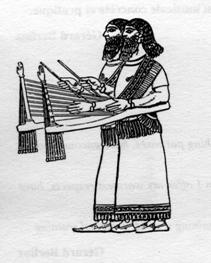 If this is indeed the etymon, then the instrument in question would be boxed shape (like a dulcimer or the Iraqi sanṭūr or sanṭīr, itself possibly derived from the Greek psaltḗrion) or have a sound box (like those famous Mesopotamian lyres that Sir Leonard Woolley discovered at Ur). The Latin word cistella referenced above, for example, can mean both a “little chest” as well as a sort of dulcimer contained within such a chest.
 As an aside, the sirma rabba whose wing is broken to dust the esqubra appears to be snub-nosed (cf. Syriac srāmā), and its description as a predator inhabiting the marshes matches that of the terrifying, prehistoric-looking shoebill (Balaeniceps rex), which routinely reaches nearly five feet in height, and whose wings can stretch to more than seven feet in width. While the closest specimens of the shoebill are today found in the marshes of Sudan and Uganda, it can be presumed that its distribution was somewhat wider in antiquity.
 Philologastry
Columbusing Classical Mandaic
Those of us engaged in producing knowledge about the phenomenon of language are invariably forced to come to terms with the quality of the prose we write, as much as we are forced to consider our own subjectivity. With regard to both of these things, there are no legitimate reasons that what we write should not be subject to the same standards as that of others, particularly when we are deliberately attempting to contribute to and influence scholarly discourse. We are social beings, every bit as much as our subjects, our colleagues, and the general reading public—which is to say that we operate as social beings when trying to influence these audiences. Grammars and dictionaries, on the other hand, provide us with one of the precious few remaining opportunities to assume what Stephan Palmié calls “the terrible fiction of a voice from nowhere” and not worry too much about the quality of our own prose or, for that matter, our own subjectivity. Perhaps this is why some philologists naturally gravitate to writing dictionaries and grammars.
And then you have Rudolf Macuch. The 20th century Slovak philologist was not only painfully aware of his own position with respect to his subject, but he also never lets us forget it. His Handbook of Classical and Modern Mandaic is a landmark of 20th century scholarship, if only because it is sui generis among grammars. Its first 25 pages establish it as a very personal account of a language, situating him within his own scholarly context through a painstakingly detailed critique of the work of his predecessors and contemporaries. At no point does Macuch ever adopt the terrible fiction of a voice from nowhere; instead, he makes certain that his voice is heard on each and every page.
Philologists are basically people who do things with words, and the primary thing that Macuch attempts to do with his Handbook is to document his personal discovery of both Classical and Modern Mandaic. In a very real sense, neither existed prior to 1965 (please bear with me on this) and he wants us to know that he was present at their making. In fact, he outlines the case that he has played a pivotal role in this making.
On p. XLVI, he informs us that “The existence of a vernacular dialect spoken by Mandaean laymen in Khuzistan, which as a living language deserves, at least, as much attention as the traditional pronunciation of the literary tongue, remained completely unknown until my personal discovery at the occasion of my visit to the Mandaean community of Ahwaz in 1953.” Unknown to whom? Obviously, by “completely unknown,” he does not mean that it was unknown to the native speakers he met, or to the thousands of their coreligionists in both Iraq and Iran, who have always been painfully aware of the ongoing shift from Mandaic to Arabic. Nor can he mean that it was unknown to his more recent scholarly predecessors, such as Jean Jacques de Morgan, who traveled to Iran and collected some texts in this language, or Samuel Marinus Zwemer, who lived in Basra around the turn of the century and published some samples of vernacular Mandaic in his Arabia: The Cradle of Islam, or Stefana Drower, who occasionally references the ratna in her publications, visited Khorramshahr and Ahwaz, and conversed fluently in Mandaic with the Mandaeans she met there, including a young Nasser Sobbi.
What Macuch can only intend by this sentence is that he has made a discovery, along the lines of Columbus’ discovery of the New World, while these previous encounters were what we might call finds. From his perspective, neither his Mandaean informants nor his scholarly colleagues were truly aware of the significance of this language, until Macuch arrived in Ahvaz to begin the laborious process of construing a discovery from these scattered finds, and thereby bring its significance to the attention of humanity (or at least that portion of humanity that reads Mandaic grammars). In order to do so, he assumes an authoritative position, that of the ultimate arbiter of linguistic norms, which requires him to subvert the authority of his informants repeatedly throughout the pages of his grammar:
and so forth. The attentive reader may well ask, what is the “correct” pronunciation of Mandaic, if not that which is used by the people who actually speak it? If I, as an American, do not employ the Queen’s English, is my language incorrect or does it actually reflect some important aspect of my own identity and its history? Obviously the latter, but equally Macuch is not incorrect, either. What he means, clearly, is that the priests are not pronouncing Mandaic correctly according to the scholarly representations of Mandaic that emerged with Nöldeke’s 1875 grammar. This representation is an entirely new scholarly enterprise, separate from but to some extent informed by Mandaic as it is understood and employed by the community, and (increasingly, as we shall see) informing this other Mandaic as well.
I do not intend to claim that Mandaeans have had absolutely no agency in constructing Mandaic as it is currently constituted. Obviously, Macuch’s Handbook of Classical and Modern Mandaic would not exist without Macuch’s Mandaean informants. In discussing his own fieldwork, Palmié might just as easily have been speaking for Macuch when he wrote, “Might not even those instances of reported speech reflect responses to questions or other dialogic cues that I provided at the time I recorded them? Conversely, might it not be that my informants steered our conversation toward a point they wanted to make―and wanted me to write up?” Every once and a while, the individual voices of Macuch’s informants pop up in his scholarship, and he faithfully records the points they wanted to make. I merely mean to suggest that what we call “Classical Mandaic” is a product of this collaboration, in much the same way that the work of creating and defining “America” began with Columbus’ discovery in 1492 and continues unabated to the present date.
The words “Classical Mandaic” and “Modern Mandaic” (or for that matter “Neo-Mandaic”) do not appear in Nöldeke’s grammar. Near as I can tell, they make their first appearance in the literature with Macuch, who is in a very real sense their creator. For Nöldeke, Mandaic is the language of a large corpus of texts, written at different times and different places, which he attempts to divide into “younger” and “older” phases primarily on the basis of foreign influences in their vocabulary and grammar. There are, of course, the classical texts, those considered canonical scripture by the community, but these too are the products of different times and places, and likewise reflect their long histories of transmission and usage.
Classical languages, as opposed to texts, are those that have been elaborated by scholars over the course of generations, and standardized through the production of dictionaries and grammars, so that they can eventually be learned and employed by non-native speakers, even after they are no longer natively spoken. This is, for example, the case for classical languages like Classical Greek, Classical Latin, and Classical Hebrew, but there is no evidence that this process of elaboration had ever occurred in Mandaic, at least not before 1875. Instead, as Nöldeke notes in his grammar, at all times and in all places, native speakers of Mandaic wrote their language exactly as they spoke it (resulting in the wide spectrum of linguistic variation he noticed). It was not until the missionaries arrived that any non-native speaker attempted to learn Mandaic, let alone write it according to any such standard. The first surviving attempt, the Leiden Glossarium, faithfully reflects the language as it was spoken at the time, rather than a self-conscious literary standard, very likely because such a thing simply did not exist at the time. Thus, in a very real sense, the history of “Classical Mandaic” begins in 1875, even if it had to wait another 90 years for scholars to come up with a name for it. This explains Macuch’s repeated insistence that the ultimate authority over “Classical Mandaic” resides among western scholars such as himself, and not among the Mandaeans, whom he relegates largely to a passive role in its construction. Classical Mandaic, as it is currently constituted, is an entirely novel enterprise, and Mandaeans who contrast their own spoken language and their own understanding of their own texts against this enterprise should do so only with their eyes wide open.
The process of constituting Classical Mandaic, and its equally factitious sisters, Neo-Mandaic (which is Mandaic as she is currently spoken) and Post-Classical Mandaic (which comprises everything else that was left on the cutting floor), continues apace, and I have made my own small contributions to this process. Demonstrating the same post-modern sensibilities as his mentor, the German philologist Rainer Voigt challenged me in his review of my grammar to consider my own subjectivity as a native-speaker of English and as the product of American scholarship in construing my own version of Neo-Mandaic, which differs from that created by Macuch in some important respects. For example, I employ a normalized phonemic transcription system, where Macuch did not attempt to isolate the phonemes of Neo-Mandaic and merely represented the phonetics of the language as he perceived them. I can only plead guilty as charged, although I do not believe that Macuch’s representation of Neo-Mandaic is any more or less accurate than my own; we are both willfully engaged in the production of something new, and our contributions to the discourse will obviously depend on how successful we are as social actors. Regrettably, I have a distinct advantage over Macuch in that he is no longer able to defend his representations of Mandaic, but he obviously still has his defenders.
Similarly, my colleagues have argued that “the pronominal system found in [Neo-Mandaic] is not in all cases the direct descendent of [Classical Mandaic],” distancing the former from the latter because it does not reflect features that we have attributed to it, e.g. the personal pronouns anat and anatun, which are unique among attested Aramaic dialects, including the contemporary language, in which we find āt and atton. In his original representation of “Classical Mandaic” avant la lettre, Nöldeke suggests that these anomalous forms of the second person singular and plural pronouns were restructured on the analogy of the first person singular pronoun. This is the representation that my colleagues currently endorse.
I can think of no four-part proportional analogy to illustrate this development (of the sort A : B :: C : D, where D is anat and anatun) internally, or any cross-linguistic data to illustrate it from other languages, so I have to be highly skeptical of this representation. I would argue that, instead, what we call “Classical Mandaic” personal pronouns are actually pseudo-historical spellings, in which segments thought lost through sound change are orthographically restored. Examples of this abound throughout the lexicon; we have aqna *ānā ‘lamb’ and aqamra *amrā ‘wool,’ as well as the anomalous form aqapra afrā ‘dust,’ in which the aq might potentially be justified on the basis of analogy, but certainly not etymology. Was the aq in these words or the an in anat and anatun pronounced at this time? Perhaps, perhaps not. They might very well have originally been purely orthographic devices (something like spelling the old shop as ye olde shoppe in a pseudo-historical English), only retrospectively recognized as linguistic reality—for which a legitimate case can be made to restore their “classical” pronunciation on the basis of the vernacular āt and atton. Such examples illustrate the degree to which our Classical Mandaic is still very much a work-in-progress. They also suggest that the retrospective nature of this work may already have been present when the texts were first composed.